
This is by way of a quick follow-on to yesterday’s post on the number of people on Twitter following science-focused users. As was pointed out, just logging the number of followers someone has on twitter is a poor indicator of either success or influence. So, spurred into action, here is a rather more sophisticated analysis of the “influence” of the tweeps in David Bradley’s list of “Scientific Twitter Friends:”
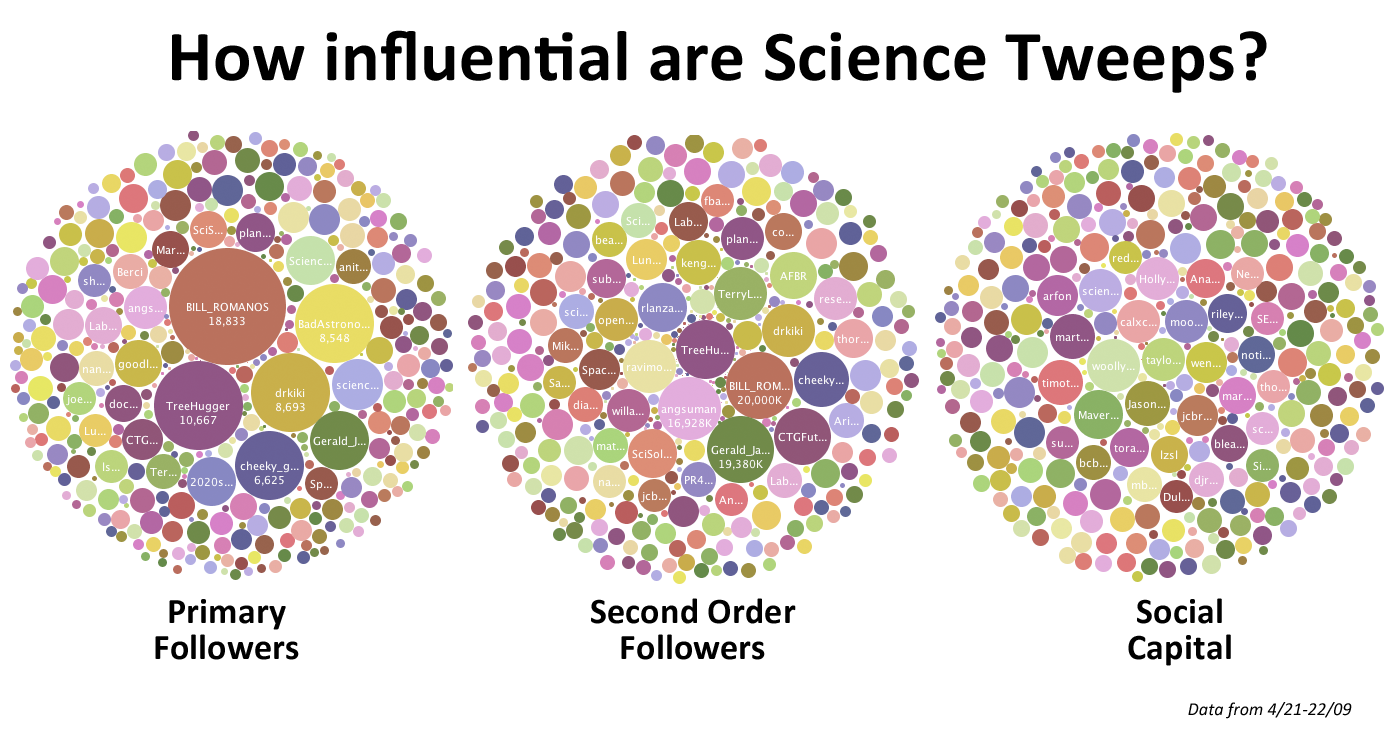
This is not the clearest graphic – even if you click on it to open a larger version – so you might like to play around with the the original. A limited interactive version showing social capital second order followers is also included below. As in the previous post, they are based on data visualization routines on the Many Eyes website…
Primary Followers: These are simply the number of people following a given tweep.
Second Order Followers: These are the number of people following the followers of the original tweep. In principle, second order followers gives an idea of how much reach a person has – if they post a tweet, and it is re-tweeted, how many people could it potentially reach. The indicator is flawed as it doesn’t account for duplicate second-order followers, but it gives a rough impression of how influential a person might be.
Social Capital: This is simply the average number of people following each of a tweep’s followers. The indicator is used by the folks at Twinfluence.com as a way of gauging the overall influence of a person’s followers – the higher your social capital, the more impact you are likely to have. Again, it’s a flawed indicator, as a person with two or three followers who in turn have a high following ends up with a very high social capital index. But it does give a different perspective on someone’s potential impact.
I’m still not sure what – if anything – this analysis really shows. But there are some interesting features. Perhaps must importantly, it’s clear that the indicated influence of someone changes radically, according to how it is measured. Taking @2020science as an example, I have a reasonable-sized bubble on the Primary Followers chart, but disappear into obscurity on the Social Capital Chart. What is also clear is that if social capital is a good measure of influence (and I’m not entirely convinced that it is yet), you don’t have to have a huge following to be a key player on Twitter. I would emphasize strongly that this this analysis shouldn’t be taken too seriously from a personal perspective – Twitter is a tool that should be used in whatever way works best for you, irrespective of rather flawed ranking systems. However, the analysis does provide insight into the Twitter community as a whole. In this particular case, not much can be inferred from a single data point. But if the same evaluation of the same group of people is carried out at regular intervals – say, every four months or so – it should be possible to chart the evolution of Twitter as a social medium for science communication. One final thought. In crunching the figures for this analysis, I was struck by an apparent lack of correlation between primary followers, secondary followers and social capital. Here are all three plotted together:
What you see is social capital on the horizontal axis, second order followers on the vertical axis, with the size of the points reflecting the number of primary followers. In among the rather scattered data, there are some interesting qualitative trends – high social capital does not associate well with high second order followers and, while there is some association between primary and second order followers, this isn’t always the case. It emphasizes again that influence depends on how you measure it!
Update 4/23/09: It’s a little flaky, but here’s a YouTube demo on playing around with the bubble chart.
Notes:
For this analysis, I knocked out any users with no followers, and two tweeps with excessively high followings (@guardiantech and @Astronautics). @BILL_ROMANOS had so many second order followers that the number was capped at 20,000,000
My thanks to David Bradley for compiling the list of “Scientific Twitter Friends” in the first place. This is largely a self-selected list of science-types on Twitter, and in no way represents the full scientific community there. But it does provide a highly useful cohort of people who profess to have a science-perspective, and can be tracked over time.
And finally, many thanks to @ruthseeley for suggesting the indicators of influence given by Twinfluence. My fingers may take longer to thank you – the analysis was a long and tedious one – but I think it was worth while!
Looks like another fascinating analysis, thanks Andrew, I need to look very closely at this to find out just influential I ain’t 😉
Thanks David,
If you haven’t done so already, check out the chart on http://manyeyes.alphaworks.ibm.com/manyeyes/visualizations/science-tweep-influence-4-22-09 – you can select your Twitter username, and see how your “influence” varies according to how you determine it. Fun, if maybe not too illuminating!
Nice statistics. Would it be possible to use something like the scientific H-factor in this statistic? Something like “Htweep is the highest number n of followers of a person that each have more than n followers”.
I think that there are a lot of fancy things that could be done with the data – especially with time series collected over a period of months/years. Makes me wonder whether there are any academics out there tracking Twitter use/impact as a social phenomenon.
Hmmm… interesting, but all this assumes that all followers are “equal”. I don’t think that they are: for example, I’m delighted to have both the new Science Minister and the Chair of the Innovation, Universities, Skills & Science Select Committee following my tweets.
That kind of direct communication to policymakers about my research is worth more to me than an army of other followers, second-order followers or whatever. For me, it’s the real value of Twitter – how many postdocs get to keep those in the heart of government informed about their research?
Another cool thing you can do on the Many Eyes site (just discovered this one):
Bring up the chart: http://manyeyes.alphaworks.ibm.com/manyeyes/visualizations/science-tweep-influence-4-22-09
Switch the color to “no selection” (bottom right menu)
Search for a particular tweep (such as “ScienceBase”) using the search box on the bottom left – this highlights that particular person on the plot.
Now switch between the three different indicators of influence (menu at bottom right of page) – you get a visual indication of how a person’s “influence” differs according to which indicator is chosen.
J – this is exactly why I make the point that the analysis is useful for understanding the group, but not individuals. I would agree – it’s way more important on a personal level who is listening to you and interacting with you, than a tally of how many people are associated with you. This is tough to capture for the group though.
OMG. Talk about setting a cat amongst the pigeons. I should never have mentioned measurement or evaluation to you. Of course you would have thought of it on your own. You’re so good at this I can’t keep up – I was going to offer to do it for you but you continually beat me to the punch. Carry on…..
Things should get interesting around 8 – 12 months from now, when I have trend data on the three indicators of influence!
The number of one’s followers on twitter is an indicator of influence because tweeps are influenced to follow for several reasons, two of which I will list in this comment. One of the first reason tweeps follow someone is after reading a users bio they realize the possibility of benefitting (emotionally and/or financial) from the users tweets and/or sphere of tweefluence. The second reason is they think the user will possibly benefit from their tweets and/or sphere of tweefluence. One more indicator of a user’s tweefluence is the amount of tweeps click on links that they post in their messages. If one uses Google Analytics, they can quickly ascertain how many tweeps were influenced by the message and clicked on the link to learn more.
This topic is a good one. Thanks for writing about it! Have an awesome day!
With your success in mind,
Ron
Oops, I forgot to mention that I use tweetburner.com to monitor how many tweeps click on links that I post. At the time of this second comment, 17 tweeps have clicked throught to read your post. 🙂
Thanks Ron,
I can see degrees and careers being based on how you measure the success/impact of social media like Twitter 🙂
I want to know what your influence upon life. David Bradley
Then add up semi-automated software system, to have information <. Action songs also introduce children to the concept of group participation. You should immediately be alarmed when you encounter SEO services company.